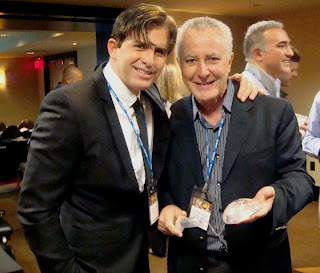
I spent the weekend as a member of the Mentor advisory panel in Santa Barbara. It is an exciting time for Mentor, as its acquisition by Johnson and Johnson was finally completed last week. They will have a new position as the powerhouse aesthetic company while their infrastructure allows them to maintain the customer relationships that are core to Mentor.
Also recently released was the six year data on their MemoryGel implant. The data is very significant, as there is an extremely low rupture rate of 1.1% in augmentation patients. The capsular contracture rate was 9.8% and re-operation rate was 19.4%, but it is a bit misleading as the re-operation rate includes size changes and minor scar revisions. The bottom line is that the MemoryGel implant is an extremely safe and useful device.
Capsular contracture remains a significant issue for all breast implants and Mentor is heavily involved in research to prevent and cure it. The photo above is of Dr. Jason Pozner (me), Josh Levine (CEO of Mentor) and Dr. Roger Wixtrom - the toxicologist and researcher involved in much of the capsular contracture research, which I collaborated on.
Oprah Winfrey's show on Thursday with guest Suzanne Somers brought up more questions about bioidentical hormone therapy. In Boca Raton, we had Dr. Mitchell Matez watching. As our resident specialist on alternative medicine, he offers a full range of bioidentical hormone therapies, and here are his answers to some of the questions left unanswered during the program. Is there any drawback to taking FDA-approved bioidentical hormones? What is the difference between them and what a compounding pharmacy provides? The term “bioidentical” is used to describe a substance or hormone that is of the exact same molecular structure as those already present in the human body. This is in direct contrast to most drug company products that are either animal (horse) derived or chemically altered to be intentionally different from human hormone so that it can be patented. The word “bioidentical” may be a “marketing” term, but the concept is clear.
One drawback to taking the FDA approved versions of these hormones is the route of administration. Any Estrogen, even bioidentical, can potentially cause clotting abnormalities when given orally due to the effects of liver metabolism. Compounded formulas can be given transdermally (through the skin) or via implantable (under the skin) pellets which will enter the bloodstream directly before the liver and drastically reduce or eliminate this problem. Ovarian hormones enter the bloodstream directly!
Another drawback is the “one size fits all” mentality used when producing the commercially available products. Most come in only one or two dosing options whereas compounded hormones can be dosed very specifically to each individual patient.
What are bioidentical hormones made from? Compounded hormones are initially derived from yams or soy. The hormones in these which are close to human but not exact are then brought to the lab and converted into exact molecular duplicates of human hormone and this is how they are administered.
Is there research saying they're safe?
There is a great deal of literature (in particularly Europe) supporting the benefit and safety of hormone therapy. The FDA does not acknowledge them.
This article from U.S. News & World Report by Lindsay Lyon gives away the biggest secret in dermatology: patients wouldn't need us so much if they would just protect their skin!
Aging of the skin comes in 2 kinds: intrinsic aging and extrinsic aging. Intrinsic aging is genetic and cannot be changed. The apple does not fall too far from the tree. So if your parents have great skin you may be lucky as well.
Extrinsic skin aging has nothing to do with genetics. It is related to environmental exposure. Such exposure includes wind, the elements and most importantly ultraviolet exposure from the sun. The more sun you get, the quicker your skin will age. The answer is easy. The most important thing we can all do is to protect our skin with sunscreens. Topical antioxidants and retinols also can help. Sunscreens at any age are a great idea. The problem is that over 90% of our sun exposure has occurred by the time we are 20 years old.
What happens in our 30s, 40s 50s and beyond? What do we do about the wrinkles, red spots and sunspots we have accumulated during the years beyond our teens? Yes, it is wise to use sunscreens at any age, but unfortunately ultraviolet protection does not reverse any of the sun damage we already have. Thankfully today we have a whole variety of non-surgical lasers that can rejuvenate the skin and reverse a lot of the damage: Fraxel, ProFractional, Titan, Accent, and Thermage treatments. You can easily erase so much cosmetic extrinsic skin aging.
Today’s laser technology has revolutionized the treatment of extrinsic aging of the skin. But don’t even think about such treatments unless you combine them with the simplest of all cosmetic treatments – a sunscreen.
It's likely to continue, as Oprah has devoted a lot of her media empire to a discussion of bioidentical hormones replacement therapy, which she is crediting for revitalizing her life. Today, she'll have Suzanne Somers on her show, which should prolong this interest.
Our bioidentical specialist at SMAC is Dr. Mitchell Matez. You can find out more about him on our website, but to clear up what bioidentical hormones are I asked him a few questions:
Q: What is the difference between bioidentical hormones and synthetic hormones?
A: Bioidentical Hormones are exact molecular copies of the hormones that naturally occur in the human body. This is in direct contrast to hormones supplied by the pharmaceutical industry and/or mainstream Gynecologists which are either chemically altered versions of human hormones or animal hormone (i.e. Premarin is horse estrogen). These are termed synthetic and are not naturally occurring in the body. We are designed to recognize and utilize our natural hormones, not those of a horse.
Q: Why aren't bioidentical hormones FDA approved?
A: Bioidentical hormones ARE FDA approved. There are a number of bioidentical products available commercially. Unfortunately they are produced with a “one size fits all” mentality which is not conducive to individualized therapy. Compounding pharmacies can provide customized formula for each individual.
Q:What menopausal symptoms can be reversed by BHRT?
A: ALL menopausal symptoms can be reversed with BHRT. In fact Menopause itself can be completely reversed!
Q: Are they safe?
A: There is a safety profile for Bioidentical hormones dating back over 70 years. There have been multiple studies demonstrating this. They are safe and effective, and do not carry the significant risks associated with synthetic hormones.
At SMAC our anti-aging division is well versed in BHRT. Dr. Mitchell Matez has brought to us an unparalleled expertise in the South Florida region. He uses personal evaluation, blood work, and other factors to determine your particular needs. Dr Matez has had extensive training and experience in Hormone Therapy and has been treating people throughout South Florida, United States, and abroad. Don’t forget to ask about Hormone “Pellets” which is a unique and efficient way to receive therapy.
This month's issue of Wired Magazine has a great chart in their Infoporn section plotting the BMI of every Playboy Playmate since 1954. This wealth of information is then compared to the average BMI of American women for every period of time.
As Playmates have gotten skinnier, American women have statistically become curvier. In 1960, the average BMI for women was 22.2, not far off from the pin-up girl "ideal" of 19.4.
This can probably be attributed to some help with plastic surgery.
From the article:
"On the touchy subject of implants, Playboy's policy seems to be don't ask, don't tell. We plotted each model's bust size (chest circumference at the fullest points) and cup size (breast volume) for all years that data were available (early '90s to now). While busts have shrunk faster than your 401(k), cup size has remained a buxom C or D. We don't think evolution can explain this phenomenon."
With our practice, the biggest change we're observing is the fit 40-something woman. After childbirth, many of our patients choose to take care of themselves and can have better bodies than most 20 year olds.
Maybe they have a little help in the breast department, and occaisonally some liposuction or a tummy tuck, but the "fit 40" is the epitomy of the Playboy ideal, and it's not as far-fetched as it may seem.
The blog Stylelist has reported on the international trend of injectable tanners, which continues to grow despite having any actual research into their long term effects.
From the blog:
"Since Melanotan activates melanocytes in the skin, it has the potential to cause cancer, as melanocytes are the cells that become cancerous in malignant melanoma. In short, Melanotan may be tricking the body into thinking it's getting more sun exposure than it actually is, which is NOT a good thing.
And there are short term side effects too: They include depression, suppressed appetite, nausea, high blood pressure, facial flushing and panic attacks. But according to a recent article in The Daily Mail, despite these dire warnings women are continuing to use the drug.
"But I feel fine using these jabs. I want to look my best at parties in strappy evening dresses and these tanning jabs give me the best colour I've ever had," says Vicky. "Far from doing me any harm, in these dark, wintry days, seeing myself glowing with health has given me a fantastic boost."
Almost all people now know that wonderful tan produced by ultraviolet exposure comes with the risks of skin cancer, wrinkles and accelerated aging of the skin. Despite this, millions of people spend hours on the beach or spend hundredsto thousands of dollars at “suntan parlors” doing their very best to get ultraviolet induced wrinkles and potentially deadly melanoma skin cancers.
Those who love the color ofa suntan without the ultraviolet associated risks use a variety of artificial topical bronzing agents. Over the courseof the last 2 decades these substances have become easier to use and generally look quite good. But know an even easier “natural” way to produce a tan has appeared – injectable melatonin. This substance when injected into humans produces melanin , the dark, protective pigment that increases after natural sun exposure. After 10 days of injections, users enjoy a warm, golden tan.
People are buying this substanceat gyms, from beauty parlors andonline. Of note in theUK the drug is legal to buy, but illegal to sell.Amazingly, this substance is also being marketed as an appetite suppressant, a rosacea treatment and even a sexual stimulant. The problem is that this substance has not undergone any regulatory testing to look at its potential long term side effects.
Joan Rivers, the comedienne who went from mocking other people's plastic surgery to mocking her own plastic surgery, was in Palm Beach this week to promote her book, "Men are Stupid... And They Like Big Boobs." According to the write-up by Robert Janjigian at the Palm Beach Daily News, the event was held at The Brazilian Court's Cafe Boulud with a packed house.
The appearance was part of her book tour, which is billed as a guide to beauty and plastic surgery. Contrary to public opinion about her, she actually had some sound advice:
"God bless the Internet." You can do a little background check on the guy (or woman).
Ask your hairdresser. "They see everything."
Choose a doctor who you feel comfortable talking to. who answers your questions thoroughly.
Go to a specialist. "If you're getting your eyes done, go to an eye guy. If getting your breasts done, go to the breast specialist. It may be boring for them, but so what?"
If you can afford it, get a cardiologist to sit in during the surgery. "Just in case."
With Botox and other injectables: "Better they put in too little than too much. I don't want to look like Liza Minelli."
"Don't be cheap about it. This is you. You can't leave this in the car."
"Put the money where they can see it."
When going in for collagen or other injections, make the doctor numb your face or get a presciption for the stuff that numbs you before you go in. "You want to feel nothing."
We're proud to say that we're participating in Mentor's study for their upcoming adjustable implants.
The new Mentor adjustable breast implant is 80% silicone and up to 20% saline. I am one of 30 plastic surgeons chosen by them to be an investigator for it.
The photo is of Dr. Hilton Becker of Boca Raton (co-investigator and inventor of the implant) and Dr. Robert Ray of Dr. 90210 fame (also a co-investigator). As you can see, this is a high-profile implant and becomes even more so when saline is added to the inner lumen.
Doctors can adjust size on the table, or with a buried port can adjust up to 6 months after surgery. The study is for primary augmentations and revision surgeries, with sizes ranging up to over 900cc.
This is the first in an innovative series of adjustable silicone implants that Mentor in working on. Women who are interested in this implant, please e-mail me and I'll refer to the closest investigator.